
NTTU Faculty of Foreign Languages students expand regional connections through ASEAN Voices 2026
NTTU – From a single online classroom, students can “travel” through multiple countries, listen to different cultural stories, and use a foreign language in real-life conversations. Through “ASEAN Voices 2026: One Country, One Day,” students from the Faculty of Foreign Languages at Nguyen Tat Thanh University gained further opportunities to broaden their understanding of the region, develop cross-cultural communication skills, and gradually shape the mindset of young citizens within the ASEAN community.
In August 2026, a series of online language and cultural exchange sessions organized by the Iloilo State University of Fisheries Science and Technology (ISUFST), Philippines, created a space for learners, lecturers, and international partner delegates to connect. Held to mark the 59th anniversary of ASEAN’s founding under the theme “Navigating Our Future, Together,” each session explored the story of a different country — its language, culture, education, and contemporary life. Throughout the 2026 series, participants learned in turn about Indonesia, Singapore, Cambodia, Malaysia, Vietnam, and Thailand, gaining a clearer sense of a Southeast Asia that is diverse yet deeply interconnected.
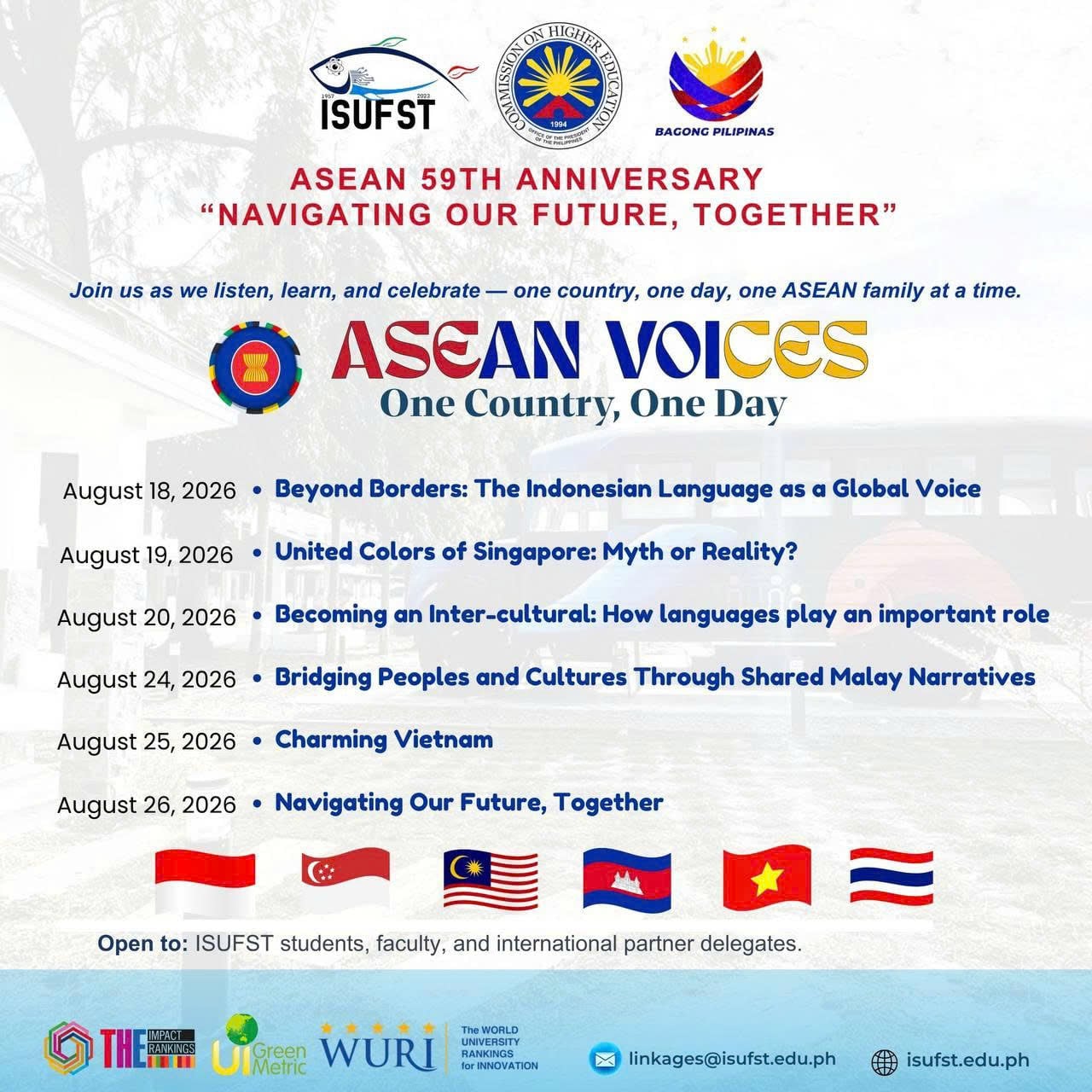
ASEAN Voices 2026 follows a “One Country, One Day” format, guiding participants through the language and cultural stories of countries across the region, one at a time
When a Foreign Language Becomes a “Ticket” to Connect with ASEAN
For students of NTTU’s Faculty of Foreign Languages, ASEAN Voices 2026 was more than an opportunity to learn about a new country or culture. More importantly, it was a chance to use a foreign language as a genuine communication tool in an international setting.
Through the online exchange sessions, students were exposed to a range of accents, expressions, and communication styles, while practicing listening, asking questions, responding, and presenting their views in English.
These experiences also helped learners recognize that effective communication depends on more than vocabulary or grammar. When engaging with people from different cultural backgrounds, learners also need to understand context, respect differences, adjust their expression, and view issues from multiple perspectives.
Sharing her experience, Le Ngoc Hoai An, a student in class 24DTA1A at NTTU’s Faculty of Foreign Languages, said:
“Through ASEAN Voices 2026, I understood more clearly that learning a foreign language can bring me closer to many different cultures. I didn’t just get to hear English spoken with different accents and expressions — I also learned more about the everyday life, people, and unique characteristics of ASEAN countries. What I liked most was the feeling that English was no longer confined to lessons, but became a real tool for me to listen, share, and connect with others.”
From this experience, learning a foreign language is no longer confined to textbooks or familiar exercises. For students, it also marks a shift from learning a language to using a language to connect — gradually becoming accustomed to conversations that extend beyond the classroom.
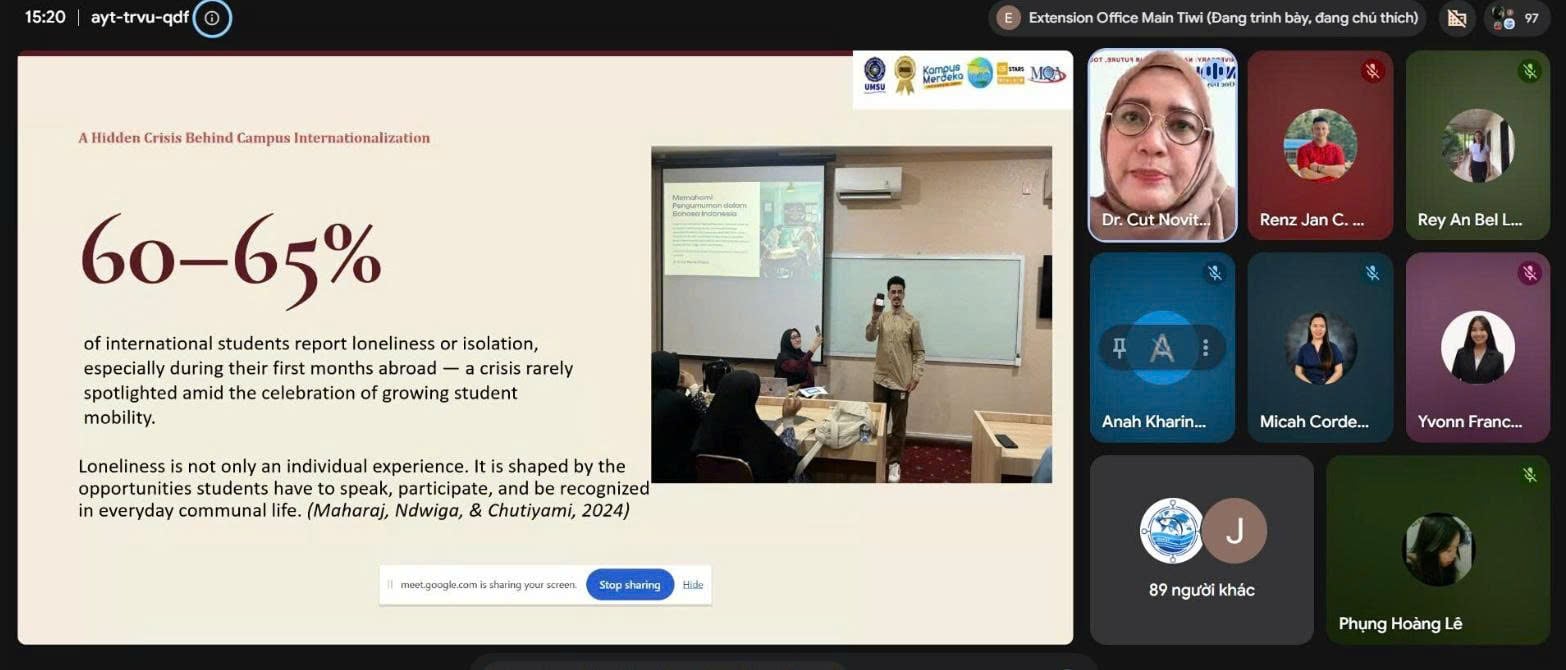
The online exchange space of ASEAN Voices 2026 connects learners, lecturers, and international partner delegates in discussions on language and culture
“Charming Vietnam”: Telling Vietnam’s Story in the Language of Integration
In the ASEAN Voices 2026 journey, Vietnam was introduced on August 25, 2026, through the “Charming Vietnam” session.
The session was led by Assoc. Prof. Dr. Tran Quoc Thao, Deputy Head of the Faculty of Foreign Languages at Nguyen Tat Thanh University. The content brought participants closer to Vietnam not only through familiar tourism imagery, but also through glimpses of its people, culture, education, and contemporary life.
While earlier sessions had learners exploring the stories of other countries in the region, “Charming Vietnam” turned Vietnam itself into the story being shared with international friends.
This highlight also revealed another role of foreign languages: not only helping learners access the world, but also enabling them to introduce their country, share their culture, and tell Vietnam’s story to the international community.
The participation of NTTU’s Faculty of Foreign Languages representative in the session helped bring the image of Vietnam and Nguyen Tat Thanh University closer to the regional academic community. For students, it also served as a vivid example of how a foreign language can bridge cultural identity and the international environment.
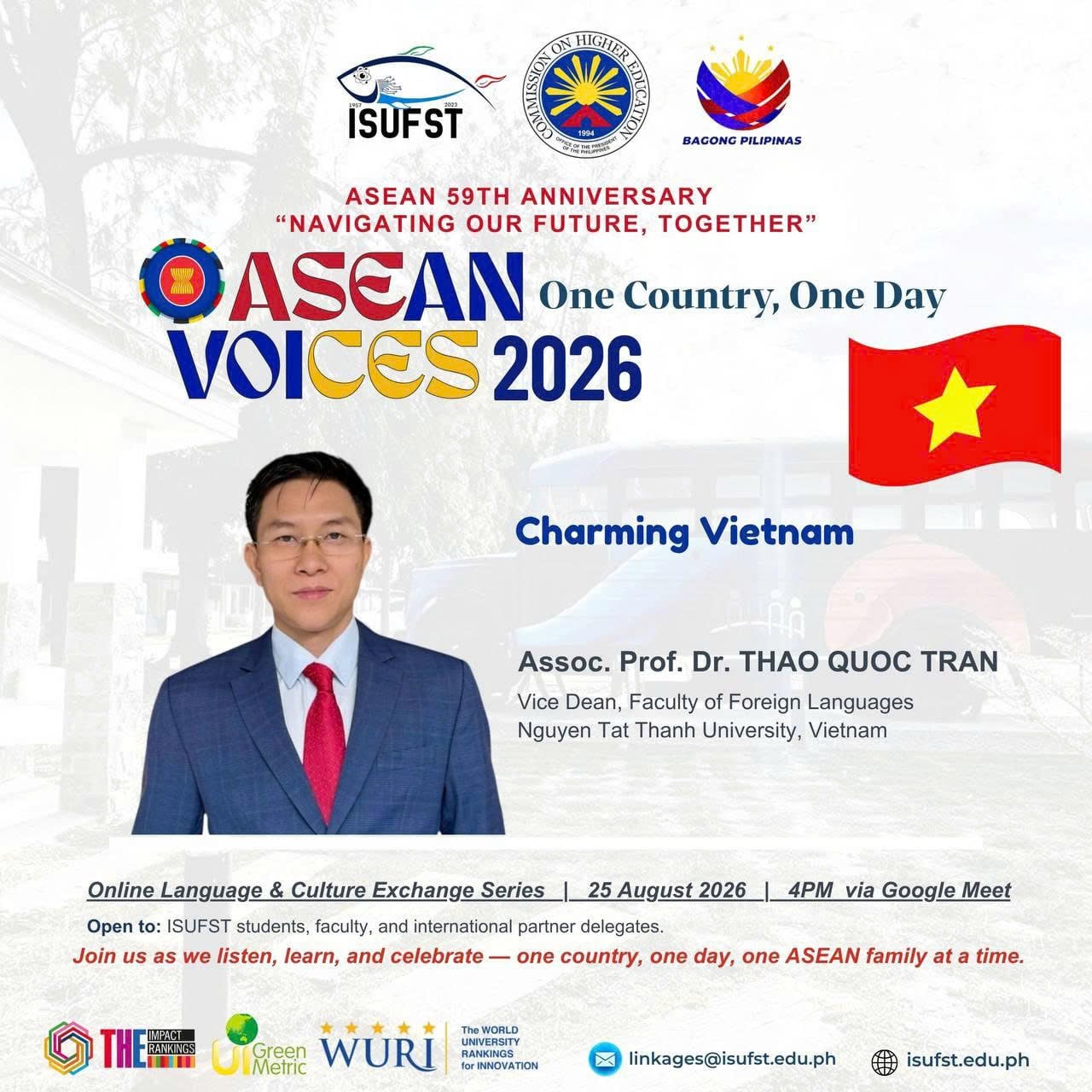
Assoc. Prof. Dr. Tran Quoc Thao, Deputy Head of NTTU’s Faculty of Foreign Languages, shares about Vietnam during the “Charming Vietnam” session as part of ASEAN Voices 2026
Looking Outward to Understand Vietnam Better
Another notable value of the program was giving learners the chance to view Vietnam in relation to its neighboring countries. In exploring Indonesia, Singapore, Cambodia, Malaysia, and Thailand, students not only recognized differences in culture, language, and social life but also had the opportunity to reflect on Vietnam’s own characteristics from a comparative perspective.
As a result, Vietnamese identity was placed within the broader picture of the ASEAN community. This process helped learners gradually understand that integration does not mean blurring one’s own identity, but rather understanding one’s own values and knowing how to share them within a more diverse space.
For students of the Faculty of Foreign Languages, this also marked an important shift from learning about culture to communicating across cultures. Through ASEAN Voices 2026, students had the opportunity to develop multiple skills simultaneously: using English in an international communication environment, listening and responding, presenting viewpoints, broadening their understanding of ASEAN countries, adapting to a multicultural environment, and becoming familiar with digital exchange activities.
Expanding an “International Space” Right at NTTU
Through online exchange activities, students can still meet international friends, engage with different cultures, take part in cross-border discussions, and form new connections while still in the midst of their studies.
For NTTU’s Faculty of Foreign Languages, activities such as ASEAN Voices 2026 help expand an “international space on campus,” where foreign-language knowledge is linked with real-world experience, cross-cultural communication, and integration skills.
In this space, every conversation is more than just a listening or speaking exercise. It is also an opportunity for students to learn to listen to others, express their own views, access new perspectives, and gain confidence as they enter learning and working environments that are diverse in both language and culture.
From stories about countries across the region to the “Charming Vietnam” session, ASEAN Voices 2026 shows that a foreign language can offer more than a professional skill. It is also a means for young people to understand the world, understand themselves more deeply, and build connections that cross borders.
For students of NTTU’s Faculty of Foreign Languages, every language learned, every culture explored, and every conversation opened marks a step closer to an international learning and working environment.
Translated by: Department of Global Engagement